Practical5 min readReviewed
Will my bag fit under the seat? A guide to personal items
More fares now include only a small bag that goes under the seat in front of you, so the question of whether a bag will fit there matters more than it used to. The answer depends on two things: the size limit in your booking and the bag itself, measured the way the airline measures it. This guide explains both, and what to do when it's close.
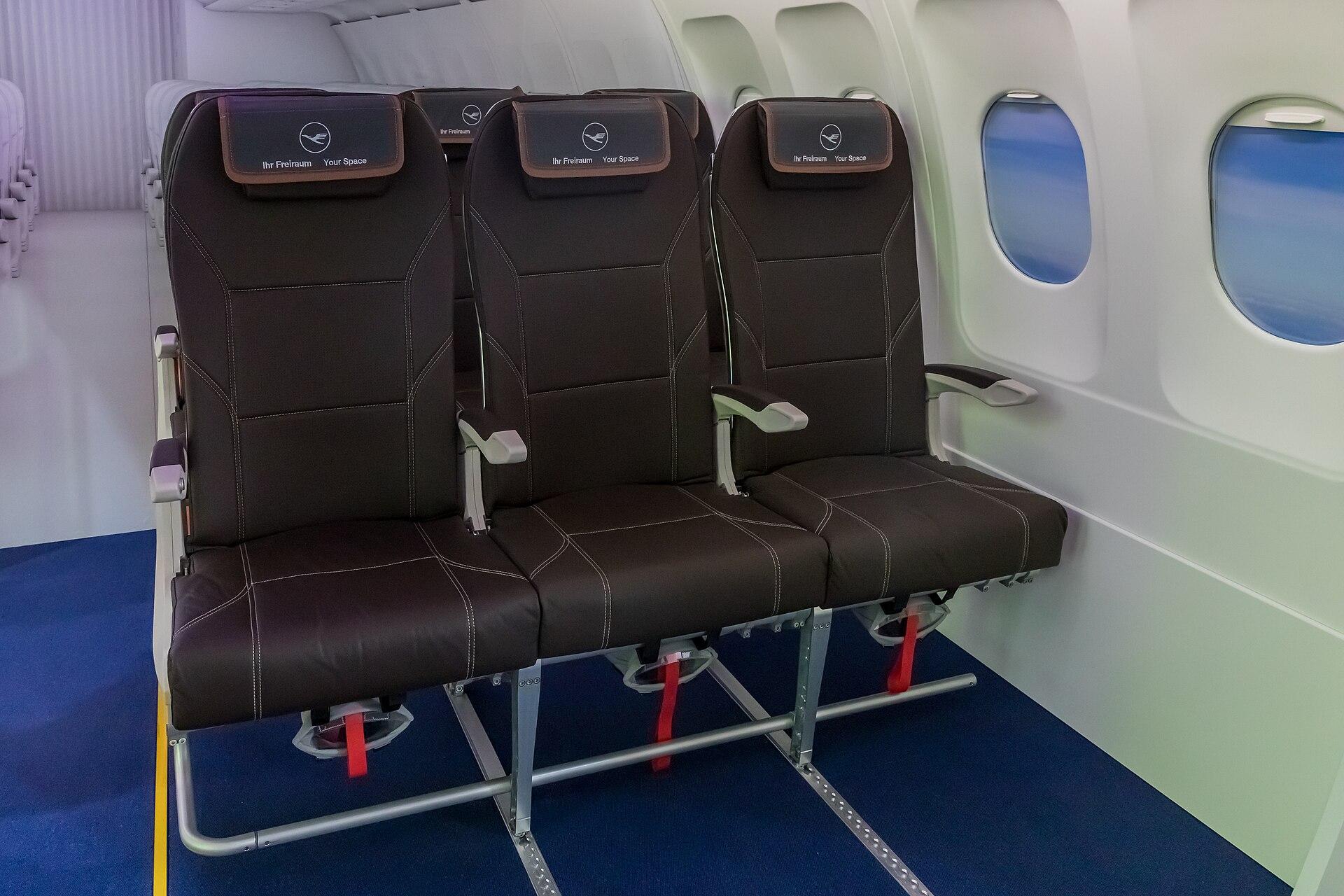
Photo: Aircraft cabin seats by Matti Blume, CC BY-SA 4.0, via Wikimedia Commons (resized and cropped).
Start with the limit in your booking
There is no single under-seat size that every airline uses. Each airline publishes its own limit for the personal item, and some set different limits for different fares or routes. The only number that counts is the one for your booking, which you'll find in the baggage section of your confirmation, the airline's website or its app.
Under-seat limits are usually given as three measurements, such as length, width and height. Common examples are around 40 × 30 × 20 cm or 45 × 36 × 20 cm, but treat these as illustrations, not rules: always copy the figures from your own airline. A few airlines also set a weight limit for the personal item, so check for one.
Once you have the figures, our free bag size checker answers the 'will my bag fit' question directly. Enter the limit and your bag's measurements, and it shows whether the bag fits, which side is too big and by how much.
How to measure your bag properly
Most bags that are refused at the gate were measured empty, or measured from the shop label. A soft bag gets noticeably bigger once it's full, so pack it exactly as you'll travel and then measure it.
Measure the longest point on each side, including anything that sticks out: wheels, feet, handles, zips and outside pockets. Stand the bag on the floor and measure to the top of the handle with the handle pushed down. If an outside pocket is stuffed, it counts.
- Pack the bag first, then measure it
- Measure at the widest point of each side, not the middle
- Include wheels, handles, feet and full outside pockets
- Write the three numbers down so you can compare them with the limit
Turning the bag can make it fit
Airlines usually care whether the bag fits within the box, not which way round it goes. A bag that is too tall standing up may fit lying on its side. The simple test is to sort your bag's sides from longest to shortest and do the same for the limit: if each of the bag's sides is no bigger than the matching side of the limit, it can be turned to fit.
The bag size checker does this sorting for you and tells you when a bag only fits once it's turned, so you know how to present it at a sizer.
Which bags fit under a seat best
Soft bags fit best because they squash slightly into the space. A soft backpack, tote or holdall with no rigid frame is easier to slide under a seat than a small hard-shell case, even when the measurements are the same.
Look for a bag that's designed to the size you need rather than a larger bag you plan to underfill: an underfilled bag still has a frame, handles and pockets that take up room. Bags with a luggage sleeve are handy, but the sleeve shouldn't add to the depth.
- Soft backpacks with compression straps
- Totes and shoulder bags without a rigid base
- Small holdalls or duffels that can be squeezed
- Laptop bags, if your laptop and essentials are all you need
The space under the seat isn't always the same
Even if your bag meets the airline's limit, the space under a particular seat varies with the aircraft. On some aircraft, equipment boxes for the seats take up part of the space under certain seats, so the room you get depends on where you sit.
Some seats have no under-seat storage at all during take-off and landing. Bulkhead rows have no seat in front, and in exit rows the floor has to be kept clear, so bags in those rows usually go in the overhead locker. If you want your bag at your feet for the whole flight, avoid those rows when you choose a seat.
Bags must also leave your feet room and not block the aisle, so a bag that technically fits but forces your legs into the aisle may still be moved by the crew.
What to pack in the bag that stays at your feet
The personal item is the bag that stays with you whatever happens. If a larger cabin bag has to go in the hold at the gate, the under-seat bag is still with you, so keep your essentials in it.
Put your passport and travel documents, phone, wallet, keys, medication and any valuables in the personal item. Power banks and spare lithium batteries generally have to travel in the cabin, so keep them in the under-seat bag too. Our carry-on packing list has a full list for travelling light, and the packing list generator builds one for your trip length and weather.
If your bag is close to the limit
If the checker says your bag is a tight fit or slightly too big, you have a few options. You can repack into a softer or smaller bag, move a bulky item such as a jacket to wear on board, or take out a few things so the bag compresses. If the bag still won't fit, adding a cabin bag or checked bag when you book is usually cheaper than paying at the gate.
To compare the cost of a fare with bags against a fare without, use our baggage fee calculator, and our guide to budget airline fees explains where the extra charges come from. If weight might be an issue, the luggage weight calculator estimates what your packed bag will weigh.
Draft your itinerary in minutes
Our AI trip planner turns your dates, budget and interests into a day-by-day plan you can refine. Check practical details with official sources before you travel.
Frequently asked questions
Will a backpack fit under an airplane seat?
Many small backpacks do, as long as they are within the personal item limit for your booking once packed. Soft backpacks without a rigid frame fit most easily. Measure it full and compare it with the limit in our bag size checker.
Do wheels and handles count in the size of my bag?
Usually yes. Airlines generally measure the whole bag, including wheels, handles, feet and outside pockets. Measure to the outermost point on each side so that the numbers match what a sizer at the gate will show.
Is the space under every seat the same size?
No. It depends on the aircraft and the seat. Equipment can take up some of the space under certain seats, and bulkhead and exit rows usually have no under-seat storage during take-off and landing, so bags go overhead.
What happens if my personal item is too big?
Policies differ, but an oversized personal item may have to be paid for as a cabin bag or checked into the hold, often for a higher fee at the gate than at booking. Check your bag before you travel to avoid surprises.
Related articles
- Personal item vs carry-on: what's the difference?Personal item or carry-on bag? What each one means, where each goes on the plane, what your fare includes and how to choose the right bag for your trip.
- Carry-on packing list: how to travel with just a cabin bagA practical carry-on packing list: what to bring, how to fit it in a cabin bag, liquids and battery rules, and tips for travelling light for a week or more.
- Budget airline fees explainedA clear guide to budget airline fees: cabin bags, checked luggage, seats, check-in, payment and change fees, and how to compare the real price of a fare.
- Lost luggage: what to do when your bag doesn't arriveYour checked bag didn't arrive? What to do before you leave the airport, how to claim for essentials, and what to do if a bag is damaged or lost for good.
- Using your phone abroad: eSIM, roaming or local SIM?How to use your phone abroad without a surprise bill: roaming plans, travel eSIMs and local SIM cards compared, plus simple settings that save data.
- How long must your passport be valid to travel?Why airlines turn away travellers with passports that haven't expired yet: validity rules, blank pages and damage, and how to check before you book.
- How to beat jet lag: before, during and after your flightPractical ways to reduce jet lag: adjusting your sleep before you fly, what to do on the plane, and how daylight and timing help you adapt after you land.
- Flying with kids: a practical guide for familiesA practical guide to flying with children: booking seats together, baby food and security, pushchairs and car seats, documents, and keeping kids happy on board.
- Getting from the airport to the city in Paris, Rome, Tokyo and LisbonHow to get from the airport to the city centre in Paris, Rome, Tokyo and Lisbon: trains, buses and taxis, plus what to check before you land.
- Travel insurance basics: what to check before you buyA plain-English guide to travel insurance: medical cover, cancellation, pre-existing conditions, excesses and exclusions, and when to buy a policy.
- Dummy ticket and flight itinerary for a visa: what is acceptedWhat a dummy ticket or flight itinerary for a visa really is, what to submit with your application, the safe and legal options and how to check a booking.
- Proof of onward travel: what it is and how to show itWhy airlines and border officers ask for proof of onward travel, who gets asked, what usually counts, and the honest options if you have a one-way ticket.
- Travel documents checklist: what to check before you goA practical checklist of travel documents and entry requirements to check before an international trip, with links to official sources for the current rules.
Official sources and further reading
Practical details such as entry requirements, prices, timetables and opening days change. Always confirm them with the official sources below before you travel. Last reviewed by the AIFlyTrip editorial team on .
- Baggage: advice for passengers (UK Civil Aviation Authority)
- Information for travellers (IATA)
- What can I bring? (security screening) (U.S. Transportation Security Administration)