Practical4 min readReviewed
Getting from the airport to the city in Paris, Rome, Tokyo and Lisbon
The first hour after landing sets the tone for a trip. Knowing how you'll get into town before you fly means no guesswork at arrivals, no overpriced rides and a calmer start. Here's how the main options work in four cities we cover, and what to check before you go.
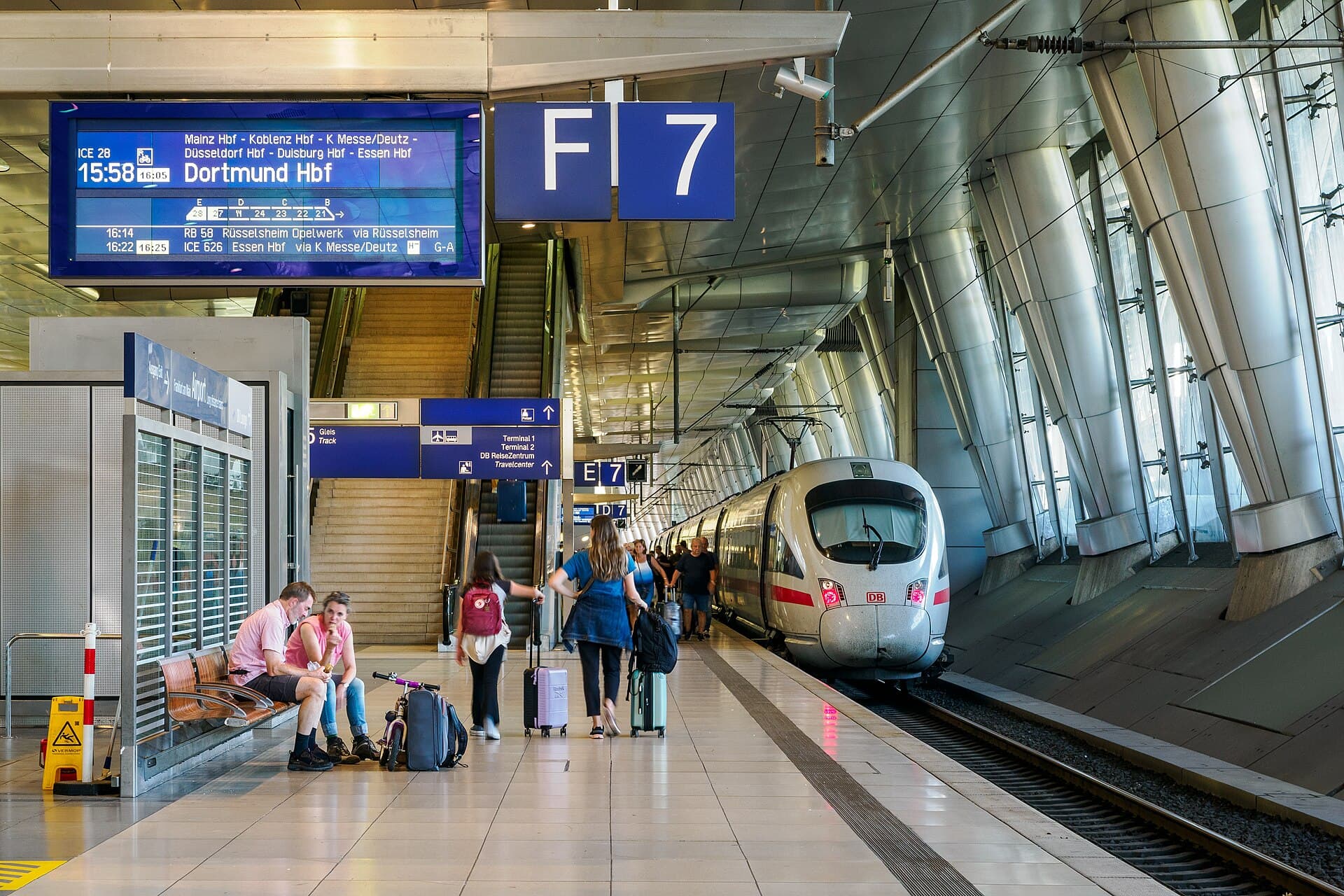
Photo: Airport railway station, Frankfurt Airport by JoachimKohler-HB, CC BY-SA 4.0, via Wikimedia Commons (resized and cropped).
Before you land: three things to check
Wherever you're flying, the same three questions decide the best route into town: what time you land, how much luggage you have, and where exactly you're staying. A train that's perfect at midday might have stopped running by the time a late flight lands, and a direct bus is worth more than a cheaper metro ride if you're carrying a big suitcase up and down stairs.
Look up the current timetable and fare on the airport's or operator's official website a few days before you travel, and save the route offline. Fares and timings change, so we haven't listed them here.
- Your arrival time, and when the last train or bus runs
- How many bags you'll be carrying, and whether stations have lifts
- The nearest station or stop to your accommodation
Paris: Charles de Gaulle and Orly
From Charles de Gaulle, the RER B suburban train runs into central Paris, stopping at stations including Gare du Nord and Châtelet–Les Halles, where you can change to the metro. It's usually the most practical option if you're travelling light. Roissybus runs to the Opéra area, and taxis between the airport and central Paris use fixed fares, which removes the worry about traffic.
Orly is closer to the city and is now served by metro line 14, which runs north through central Paris. There are also bus options and taxis. Whichever airport you use, check the RATP website for current routes before you go. Once you're in town, our Paris travel guide and Paris in 3 days itinerary take it from there.
Rome: Fiumicino and Ciampino
Most international flights land at Fiumicino. The Leonardo Express train runs nonstop to Roma Termini, the main station, which suits most central hotels. Regional trains on the FL1 line are an alternative if you're staying near Trastevere or Ostiense, and they're often cheaper. Taxis from Fiumicino to the historic centre charge a fixed fare.
Ciampino, used mainly by low-cost airlines, has no direct rail link at the terminal; buses run to Termini and to Ciampino town station for onward trains. Check Aeroporti di Roma's website for the current options. Our Rome travel guide covers getting around once you arrive.
Tokyo: Haneda and Narita
Haneda is the closer of Tokyo's two airports. The Keikyu line and the Tokyo Monorail both connect it to the rail network in central Tokyo, and airport limousine buses go direct to many hotels and major stations, which is handy with heavy bags.
Narita is further out. The JR Narita Express and the Keisei Skyliner are the fastest rail links into the city, and there are cheaper buses and slower trains too. If you're arriving tired after a long flight, a direct bus to your hotel can be worth it. Our Tokyo travel guide explains IC cards, which work on most trains and buses once you're in the city.
Lisbon: Humberto Delgado Airport
Lisbon's airport is unusually close to the city. The metro's red line starts at the airport, and you can change to other lines for the centre; it's simple and good value if your bags are manageable. The Aerobus runs to central areas such as Baixa and Cais do Sodré, and taxis and ride-hailing cars are widely available for the short trip.
If your hotel is up one of Lisbon's many hills, a taxi straight to the door can save a steep walk with luggage. Our Lisbon travel guide and Lisbon in 3 days itinerary help you plan the days that follow.
Taxis, ride-hailing and avoiding the common traps
At most big airports, official taxi ranks are clearly signed outside arrivals. Use those, or an app you trust, rather than accepting offers from people approaching you inside the terminal. Where fixed fares exist, as in Paris and Rome, confirm the fare before you set off.
If you're arriving late at night, it's worth booking a transfer in advance or at least knowing the official taxi option, so you're not left working it out after the last train has gone.
Plan the first day around your arrival
However you get into town, keep the arrival day light. Drop your bags, take a walk nearby and save the big sights for the next morning. Our guide on how to build a travel itinerary explains how to plan around flight times, and our AI trip planner drafts a first day that fits when you land.
Draft your itinerary in minutes
Our AI trip planner turns your dates, budget and interests into a day-by-day plan you can refine. Check practical details with official sources before you travel.
Frequently asked questions
Is the train or a taxi better from the airport?
Trains are usually cheaper and avoid traffic, which makes them a good choice if you're travelling light. Taxis make more sense late at night, with heavy luggage, or when several people share the fare.
Can I use public transport from the airport at night?
It depends on the city and the line. Many airport trains stop running late in the evening, so check the last departure on the official website and have a backup plan, such as an official taxi.
Should I book an airport transfer in advance?
It's worth considering for late arrivals, travel with young children or lots of luggage, or if you'd rather not navigate transport after a long flight. For daytime arrivals, trains and buses are usually straightforward.
Related articles
- How to make a travel itinerary that actually worksHow to make a travel itinerary that works: pick a few anchors, group days by area, count travel time honestly, add buffers, plus a simple day-by-day template.
- How to find cheap flights: a step-by-step methodA practical method for finding cheaper flights: flexible dates, nearby airports, fare types, the true total cost, price alerts and when to book direct.
- Dummy ticket for visa: what embassies really acceptWhat a dummy ticket is, what visa applications usually ask for, the safe and legal options, why fake tickets are risky and how to check a booking is real.
- Travel documents checklist: what to check before you goA practical checklist of travel documents and entry requirements to check before an international trip, with links to official sources for the current rules.
Ready-made itineraries
- Paris in 3 daysA realistic three-day Paris itinerary for first-time visitors, grouped by neighbourhood, with museum timing tips and ideas to adapt it to your pace.
- Tokyo in 5 daysA five-day Tokyo itinerary that groups the city by neighbourhood, mixes busy districts with quiet ones and includes a day trip to Kamakura or Hakone.
- Lisbon in 3 daysA three-day Lisbon itinerary covering Alfama, Baixa, Chiado and Belém, plus a day trip to Sintra, with tips for the hills, trams and timing.
Destination guides
- Paris travel guidePlan your Paris trip: which neighbourhoods to explore, how many days to spend, when to visit, getting around by metro and practical tips for first-timers.
- Rome travel guidePlan your Rome trip: how many days to spend, when to visit, how to group the Colosseum, Vatican and historic centre, getting around and practical tips.
- Tokyo travel guidePlan your Tokyo trip: which neighbourhoods to explore, how many days to spend, when to visit, getting around by train and IC card, and easy day trips.
- Lisbon travel guidePlan your Lisbon trip: which neighbourhoods to explore, how many days to spend, when to visit, trams and transport cards, and day trips to Sintra and Cascais.
Official sources and further reading
Practical details such as entry requirements, prices, timetables and opening days change. Always confirm them with the official sources below before you travel. Last reviewed by the AIFlyTrip editorial team on .
- Paris airports: access and transport (Paris Aéroport (Groupe ADP))
- Paris public transport (metro, RER, buses) (RATP)
- Rome Fiumicino and Ciampino airports (Aeroporti di Roma)
- Tokyo Haneda Airport: access (Tokyo International Airport (Haneda))
- Narita International Airport: access (Narita International Airport)
- Lisbon Airport: transport to the city (ANA Aeroportos de Portugal)